
More Americans died in British captivity than on the battlefield, and both armies found use for that fact.

Key Takeaways
- Roughly 11,500 Americans died aboard British prison ships in Wallabout Bay, a toll that far exceeds the roughly 6,800 Americans killed in battle across the entire war.
- The HMS Jersey, launched in 1736 as a 60-gun fourth rate designed to carry about 400 sailors, held around 1,200 prisoners at a time, and survivors described it as a little epitome of hell.
- Britain’s treatment of captured Americans rested on a legal position, not simply cruelty: rebels were classified as traitors and pirates, which placed them outside the prisoner-of-war conventions that governed European warfare.
- Historian Edwin Burrows estimates roughly 32,000 Americans were held prisoner and about 18,000 died in captivity, figures considerably higher than the older estimates still found in most reference works.
- Both sides made use of the prisoners: the British offered captives release in exchange for enlistment, and Patriot newspapers publicized conditions to harden civilian resolve and discourage surrender.
The Story We Usually Tell, and What It Leaves Out
Most accounts of the American Revolution move from battle to battle, and prisoners appear only when an army surrenders. Saratoga and Yorktown produce captives; the narrative follows the armies onward. What happened to those held for years in New York Harbor rarely enters the story at all.
This detail is a strange omission, because by any measure of scale it belongs near the center. The British prison ships of the American Revolution killed more Americans than the fighting did, concentrated in a few square miles of water off Brooklyn.
The episode also resists easy handling, which is part of why it gets skipped. It contains genuine atrocity, a serious British legal argument, contested numbers, and a century of American commemoration that shaped how the facts were transmitted. This piece separates those layers.
What the Prison Ships Actually Were
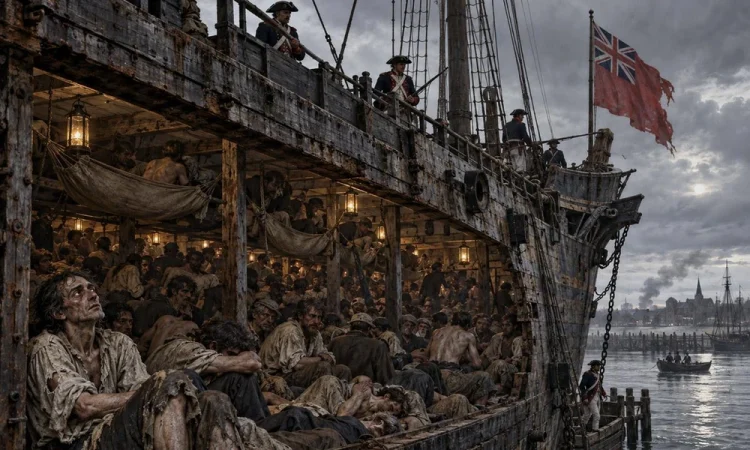
The short answer: They were decommissioned or damaged warships and transports, moored in Wallabout Bay near what is now the Brooklyn Navy Yard, converted into floating prisons because Britain held New York City from 1776 to 1783 and had nowhere else to put thousands of captives.
Sixteen such vessels were used over the course of the war. The most notorious was the HMS Jersey, a 60-gun fourth-rate launched at Plymouth in 1736 and long past its service life, stripped of rigging and anchored as a hulk.
The National Park Service records that the Jersey was designed to accommodate roughly 400 sailors and held approximately 1,200 prisoners. Men were confined below decks in darkness, with inadequate ventilation, no sanitation to speak of, and rations that survivors described as scraps of spoiled pork, wormy bread, and brackish water.
Dysentery, typhus, and smallpox moved through the holds continuously. Burial details carried roughly eight to twelve bodies ashore daily from Jersey during the worst periods, interring them in shallow graves along the shoreline where tides and erosion repeatedly exposed them.
A ship built for four hundred sailors held twelve hundred prisoners, and the dead were buried in sand that kept giving them back.
Why Britain Treated Rebels Differently
The short answer: Eighteenth-century European warfare had established conventions for prisoners of war, including exchange cartels and officer paroles. Britain did not extend these to Americans, because doing so would have implicitly recognized the United States as a sovereign belligerent rather than a collection of subjects in rebellion.
This is the part of the story most often flattened into simple villainy. British commanders faced an actual legal problem: a captured American was, in the Crown’s view, a traitor, and treason was a capital offense. Formally recognizing rebels as lawful combatants would have conceded the central political question of the war.
The practical result was that captured Americans occupied a legal void. They were not tried as traitors, which would have created martyrs and invited retaliation, but neither were they granted the protections of legitimate prisoners. Commanders had wide discretion, and Burrows documents that some used it to punish captives at will.
None of this excuses the conditions. It does explain why they persisted: there was no framework compelling Britain to maintain standards, no neutral inspection, and no exchange system that would have emptied the ships.
Exchanges did occur sporadically, negotiated case by case, but never systematically enough to relieve the overcrowding that killed people.
EVIDENCE CHECK: The prison ships are often described as a deliberate British extermination policy. The evidence supports something different and not much more flattering: a combination of a legal position that stripped prisoners of protection, administrative indifference, chronic supply failure, and individual commanders who abused discretion. Systemic neglect on this scale produces atrocities without requiring a policy of atrocity.
The Numbers Historians Argue About
The short answer: The traditional figure of 11,500 prison ship deaths has been carried in reference works and on the Brooklyn monument for over a century. Edwin Burrows, in Forgotten Patriots: The Untold Story of American Prisoners During the Revolutionary War, argues the true scope was larger: roughly 32,000 prisoners were held, of whom some 18,000 died.
The disagreement is not trivial. Howard Peckham’s widely cited tabulation in The Toll of Independence puts total American military deaths at 25,324, with about 6,824 killed in battle, roughly 10,000 dead in camp, and about 8,500 dead in captivity. Burrows’s captivity figure is more than double Peckham’s.
The discrepancy arises from what the sources allow. Prison ship records were poorly kept and partly destroyed, civilian prisoners and privateer crews were inconsistently counted, and men who died shortly after release were often recorded, if at all, as ordinary deaths.
We do not know how many Americans died in British captivity, and the uncertainty is itself part of the history.
What every estimate agrees on is the comparison that matters most: more Americans died as prisoners than died in combat. Whether the ratio is roughly equal or better than two to one, the Revolution’s deadliest place for Americans was a harbor, not a battlefield.
How the Dead Were Used
The short answer: The suffering was real and it was also useful. British officers offered prisoners release in exchange for service in the Royal Navy or Loyalist units, and Patriot printers publicized the conditions to stiffen civilian resolve and make surrender look worse than fighting.
The British recruitment offer is documented and appears to have largely failed. Accounts emphasize that most prisoners refused, choosing continued confinement over enlistment, which is remarkable given what refusal meant. Some did accept, and the sources are too thin to say precisely how many.
On the American side, prisoner accounts circulated in newspapers and pamphlets throughout the war, presented as evidence of British barbarity. This was accurate reporting that also served a purpose, and both things can be true at once.
The propaganda function intensified after the war. The remains washing out of the Brooklyn shoreline became a physical argument about national sacrifice, and their treatment followed a long political arc: first interred in 1808, relocated to Washington Park in 1873, and finally placed in a crypt beneath the Prison Ship Martyrs’ Monument in Fort Greene Park.
That monument, a 149-foot Doric column designed by Stanford White with sculpture by Adolph Weinman, was dedicated on November 14, 1908, with President-elect William Howard Taft in attendance. It was restored in 2008.
Why the Story Faded Anyway
Given a 149-foot monument and a death toll exceeding the Revolution’s combat losses, the obscurity of this episode requires explanation.
Part of the answer is narrative shape. Prison deaths lack the structure that military history rewards: no commander made a decision, no maneuver succeeded, and nothing turned. The dead accumulated slowly in conditions that produced no engagement to name.
Part of it is Anglo-American relations. By the time the monument went up in 1908, Britain was becoming a strategic partner, and a national memorial to British atrocity fit awkwardly with the diplomatic moment.
And part of it is that the victims were disproportionately sailors and privateers rather than Continental regulars, men outside the institutional army whose service generated fewer pension records, fewer regimental histories, and fewer descendants organized to remember them.
Why It Still Matters
The prison ships illustrate how national memory is selective. An episode can be enormous in scale, well documented, and physically memorialized, and still fall out of the standard account because it does not fit the form a founding story is expected to take.
It also demonstrates that acknowledging propaganda does not require doubting the underlying events. Patriot printers used the prisoners to make a political argument, and the conditions they described were real. Reading the sources critically means holding both, not choosing one.
Finally, the contested numbers are a useful lesson in how history works. When a figure like 11,500 appears on a monument and in reference books for a century, it acquires a solidity the evidence never supported. Burrows’s revision is not a debunking; it is a reminder that a number carved in granite is still an estimate.
Frequently Asked Questions
How many Americans died on British prison ships? The traditional figure is more than 11,500 deaths in Wallabout Bay. Historian Edwin Burrows estimates that about 18,000 Americans died in British captivity overall, from about 32,000 prisoners held. Records were poorly kept and partly destroyed, so no exact count is possible.
Did more Americans die in captivity than in battle? Yes, by every major estimate. Howard Peckham’s tabulation puts battle deaths at roughly 6,824, while deaths in British captivity range from about 8,500 in Peckham’s own count to some 18,000 in Burrows’s. The prison ships alone are credited with more than 11,500 deaths.
What was the HMS Jersey? A 60-gun British fourth rate launched in 1736 and later stripped and moored as a prison hulk in Wallabout Bay off Brooklyn. Designed to carry about 400 sailors, it held roughly 1,200 prisoners at a time and accounted for the majority of prison ship deaths.
Why did Britain refuse to treat American prisoners as prisoners of war? Granting formal prisoner-of-war status would have implied recognition of American sovereignty, the central issue of the war. Britain classified captured rebels as traitors, which left them outside the exchange cartels and paroles that governed European warfare and stripped them of protections.
Where is the Prison Ship Martyrs’ Monument? It is located in Fort Greene Park, Brooklyn, New York. The 149-foot Doric column, designed by architect Stanford White with sculpture by Adolph Weinman, was dedicated on November 14, 1908, and contains a crypt holding remains recovered from the Wallabout Bay shoreline. It was fully restored in 2008.
Further Listening & Reading
Hear historians take up these questions in the AAR interview series and History Behind News episodes. For more on the war as soldiers and civilians experienced it, see The Revolutionary War collection and The British Perspective, or browse the full Themes of the American Revolution.


